
Our Process
Paint that
chases the metal.
Conventional spraying throws paint at a surface and hopes most of it lands. Electrostatic painting makes the paint want to go there. The result is a thinner, more even film, far less overspray, and coverage on faces a brush or roller never reaches.
The Physics
Opposite charges do the work
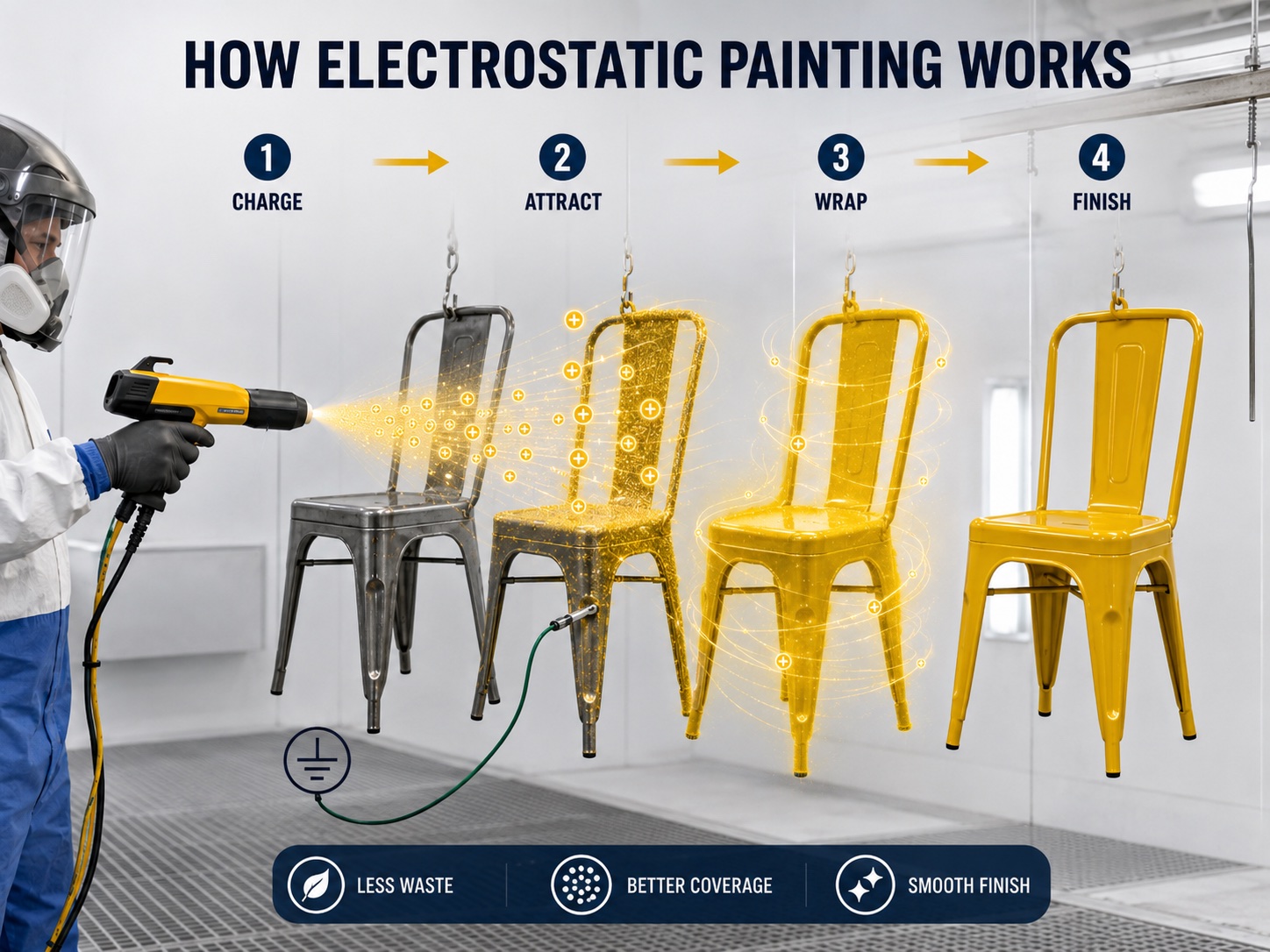
As the paint leaves the gun it passes an electrode that gives every atomised droplet a positive charge. The workpiece is clamped to earth, so it carries a negative charge. Because like charges repel, the droplets push away from each other and spread into an even cloud instead of a concentrated jet. Because opposite charges attract, that cloud is pulled onto the metal from every direction at once.
The effect worth paying for is wrap-around. Droplets that overshoot the front of a picket curve back onto its sides and rear, so a railing gets coated all the way round in a single pass — no reaching behind bars, no missed backs, no thin spots where a brush could not fit.
See It Applied
What to watch for
Notice how little of the coating drifts. In conventional spraying a large share of the material misses the target and settles on whatever is downwind — which is why most shops will not spray a railing above an occupied balcony.
Here the charge holds the cloud on the metal. That is what lets us work on a live property, and it is why the finish reaches the backs of the pickets without anyone dismantling the railing.
Six Steps, Every Job
-
01
Assessment
We walk the job, identify the substrate and check the existing coating for adhesion, chalking and rust. That determines the prep, the primer and the honest answer on whether recoating beats replacement.
-
02
Containment & Masking
Drop cloths, plastic and tape go up before anything else. On occupied balconies this is the difference between a finished job and a complaint — residents keep using the property while we work.
-
03
Surface Preparation
Wash, degrease, scrape and sand. Loose coating and corrosion come off, glossy surfaces get keyed, and the metal is left clean and dry. This is the step that decides how long the finish lasts.
-
04
Priming & Grounding
Bare or corroded areas get a compatible primer. The workpiece is then clamped to a ground lead — without a solid earth path there is no charge differential and no wrap-around.
-
05
Electrostatic Application
Charged coating is applied in even passes. Transfer efficiency is high, so material use and overspray drop sharply compared with conventional spraying — which is why this works on an occupied site at all.
-
06
Cure & Inspection
The coating cures to a hard, uniform film. We pull the masking, walk the work with you and touch in anything that needs it before we leave.
Why It Wins
-
Complete Coverage
Wrap-around reaches the backs and sides of pickets, scrollwork and louvres in one pass.
-
Less Overspray
Charged droplets follow the metal instead of drifting, so neighbouring surfaces stay clean.
-
Minimal Downtime
Work happens in place. No dismantling, no crating, no weeks without a railing or a gate.
-
Lower Lifetime Cost
Recoating existing metal costs a fraction of replacing it, and the finish holds for years.
Ready to see it on your property?
We will walk the job, tell you whether recoating is the right call, and quote it straight.